Marti Friedlander's work is proudly displayed at FHE Galleries in Auckland.
Born in England to Russian Jewish immigrants, from the age of three she was raised in orphanages[1] together with her sister Anne.[2] She married Gerrard Friedlander, a New Zealander of German Jewish origin, in 1957[2] and emigrated to New Zealand[3] in 1958. In New Zealand she worked as a nurse for her husband who worked as a dentist. After she lost their first child in 1963 she was spurred onwards to take photos of other children. As an outsider she found herself in a strange land, and began taking photographs to document and understand the country she had adopted.
Friedlander felt constrained by what she saw as New Zealand's conservativism compared to the lifestyle she had enjoyed, and documented and challenged this in her photography and social activism. Her work involved collaboration with Michael King while photographing Maori women and moko.[4]
Friedlander has had exhibitions at a number of galleries.[5] She was admitted as a Companion of the New Zealand Order of Merit in 1998, and was the subject of a documentary by Shirley Horrocks entitled Marti: the Passionate Eye.[6]
Supported by the Arts Foundation, the Marti Friedlander Photographic Award was launched in 2007. The Award is presented every two years to an established photographer with a record of excellence and potential to continue working at high levels. The Award includes a $25,000 donation for the photographer to help further their career.
Marti Friedlander’s photographs have offered great insight into the way New Zealand has established a more complex and compelling identity over multiple generations. She has been instrumental in independently documenting the changing nature of contemporary post war New Zealand through the protest and woman’s movements – the ever-changing roles of men and women and that of Maori and Pacific Societies.
Still Light: The Photography of Marti Friedlander is a selection of images that hold a very strong mirror as to who we are and how we have come to be.

Marti Friedlander, Self-portrait (1961)

Twelve questions with Marti Friedlander
5:30 AM Thursday Oct 25, 2012
Marti Friedlander was born in 1928 to Russian Jewish parents. She was raised in an orphanage, with her sister, from the age of 3. Marti emigrated to New Zealand from Britain in 1958 and began taking photographs of people, places and protests. Friedlander is 84 and lives in Auckland with her husband, Gerrard.
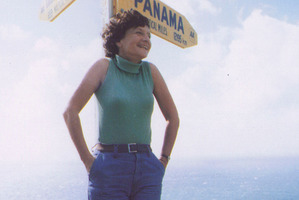
1. What compelled you to pick up a camera and start taking pictures of faces that weren't famous?
I started because I came to a country where there was so little recognition of the arts - of artists, musicians, whatever. I decided I was going to seek out all these people who were so gifted but working alone and take photographs of them because one day people would be interested. I was trying for my own sake to find associations with people I had something in common with.
2. How were you regarded as the stranger with the camera?
Because of love I came to New Zealand and I was completely lost. And then I looked around me and I thought, this place is so strange why not photograph it? See it as a stranger. I had a constant state of wonder. I was fascinated by this country, which was so different to where I'd come from. It was rural. It was provincial. It was actually quite cold. It was different in terms of human relationships. I'd never encountered so much drinking.
I hadn't been used to that. I was seen as a stranger too because I was weird. I was very bohemian and I wore yellow stockings and things like that.
3. Do you think you have a particular affinity with "difference" or those who are disadvantaged because you grew up in an orphanage?
I think "disadvantage" is often a state of mind. I could've spent my life saying, "Poor me". But I didn't because I thought I was incredibly fortunate. You know, I've never thought much of nuclear families. Most of them are so dysfunctional and they always were. My life was very secure, growing up. We knew when we went to sleep. We knew when we got up. We had lots of friends. We were living with hundreds of other children. We learned to relate to people and got an understanding that you have to get on in life. I also had a tremendous regard for anyone who was different.
4. How have you suffered prejudice?


I was in an orphanage because my parents were Jewish in Russia. Any Jewish person will be able to go back to their ancestry and there will be prejudice. But lots of people suffer prejudice. People might not like you because you're blonde or because of the way you look. It would be dishonest to say we all don't have prejudices either. The thing is to learn how to cope with your prejudices.
5. What do you see when you look at a self-portrait of yourself in, say, 1958?
I have lots of portraits and I show them to Gerrard and say "Darling, why didn't you tell me I was so attractive?" It's true. New Zealand men don't do that. I wasn't aware I was attractive then. I look back now with a sense of absolute thrill. And also when I see photos of my sister. It is good to look back.
6. What's the most beautiful thing about an ageing face?
I experienced that when I first read about moko in 1970 - I always loved old people. I longed for faces that showed character. Lines. Everything. It's in the eyes - expressive eyes. I see some old faces and they look absolutely battered and worn down. It's not very good getting old. You wake up in the morning and your spirit says, "Isn't life fantastic," but your body tells you, "But your life is limited." Pains and aches. I think old people have a lot of courage, which is not often recognised. Age levels everything out. You can't be up yourself when you're old.
7. What was the first photo you took in NZ?
The All Blacks 1960 anti-South Africa tour protests at Myers Park and the banner reads, "I'm all white Jack". I said to Gerrard, we must go there. I was such a political person. I was very affected by that protest because it was so gentle. It wasn't aggro. It was people who just felt the tour shouldn't go ahead. That image was bought by the BBC for a film on rugby. It's a tremendous slogan. Often when I photograph protests I'm interested in the slogans and some were really witty. Like "Unemployment is not working." Brilliant.
8. What is you see at that moment you push the shutter?
Usually I push the shutter because I say: "That's it." It's so succinct and so essential. It can be something that I just feel has to be retained. I photograph what I see - it's a thinking image. Something that says something to you immediately, like a conversation. It's so spontaneous. I don't look for images. I actually see them. It's as though you're exclaiming: "My goodness - I've just seen something fantastic in life." If you go searching for images there's a kind of heavy-handedness.
9. Are you impulsive?
Oh yes definitely. I'm not impetuous but I am impulsive. And I'm very emotional of course.
10. What do you look forward to?
To die without too many regrets. We've all said or done things we shouldn't have so you have to forgive yourself when you get older. That's life. You're human and vulnerable.
11. What have you always known?
Don't ever envy others and try not to have big expectations. My life was very difficult but we all have tragedy in our lives. But it's how you cope with it. I've been loved a lot. My sister and I had that because we had each other and we affirmed each other. We had such a close relationship. We laughed a lot. I'm not sentimental.
12. What do you and Gerrard love about each other after 56 years of being together?
We do love each other, so much, still. And don't believe that when you get old you don't still feel that flutter. You do. It shows that your body is still working and the nerve endings are alive. As you get old it's lovely to live with a person whose face you love. I just love Gerrard's face. There's a kind of innocence and a sweetness there. He's a very compassionate man and he's still so utterly curious. And now we're in our 80s can you imagine if we were sitting together when one of you was becoming old and disinterested. What I love about Gerrard is he's restless. Interested.
In the 2004 documentary The passionate eye, Marti Friedlander explains how and why she became a professional photographer. Unlike her peer Ans Westra, who has minimal interaction with her human subjects, Friedlander converses freely with the people she photographs.
About this item
Point of View Productions
Reference: Marti: the passionate eye [videorecording]. Producer and director, Shirley Horrocks. Auckland: Point of View Productions, 2004
Reference: Marti: the passionate eye [videorecording]. Producer and director, Shirley Horrocks. Auckland: Point of View Productions, 2004
This item has been provided for private study purposes (such as school projects, family and local history research) and any published reproduction (print or electronic) may infringe copyright law. It is the responsibility of the user of any material to obtain clearance from the copyright holder.
Marti Friedlander
Marti Friedlander (1928 - ) emigrated to New Zealand in 1958. She is one of New Zealand's leading 20th Century photographers. Friedlander writes of her beginnings as a photographer "As I traveled around both islands... I compiled an image album of New Zealanders going about their everyday lives. Everything I saw then seemed extraordinary, and I would ask Gerrard [her husband] to stop the car so that I could take photos. “It’s so New Zealand!” was my catch-cry, and my excitement could not be contained. I also sensed that I was capturing a world that would change over the next decade or so." New Zealand Fine Prints stocked a great poster from the acclaimed Auckland Art Gallery retrospective of Friedlander's work which featured the superb image "Shearers, Balclutha". This was the only reproduction of Friedlander's photography currently in print but has unfortunately just sold out. Until more of her work is published as fine art prints please check out our NZ photography collection for work by other great NZ photographers.
Self-Portrait

Marti Friedlander, with Hugo Manson
‘Seeing unexpected things in the lens is what I was about.’
From a childhood in London’s East End to half a century in New Zealand photographing wine-makers, artists, children and kuia, Marti Friedlander has lived a rich life – one defined by the art of looking. In Self-Portrait, Marti tells her story for the first time. As forthright and revealing in words as in her photographs, she tells of growing up in London orphanages, being Jewish, working in a Kensington photography studio, marrying a New Zealander and moving across the world to a challenging new country. Here she began to photograph the ordinary and the extraordinary, protests and politicians, balloons and beaches – capturing on film the transformation of New Zealand life over more than fifty years. This book is a rich meditation on one woman’s photographic journey through the twentieth century.

Authors
Marti Friedlander (born 1928) is New Zealand’s leading photographer. Since immigrating to New Zealand in 1958, she has worked throughout New Zealand, the Pacific, England and Israel. Her work features in books including Moko: The Art of Maori Tattooing (with Michael King, 1972), Larks in a Paradise: New Zealand Portraits (with James McNeish, 1974) and Contemporary New Zealand Painters: Volume One, A–M (with Jim and Mary Barr, 1980). Marti’s photography was the subject of a retrospective at Auckland Art Gallery in 2001, which subsequently toured the country. Her work is the subject of a number of books including Marti Friedlander by Leonard Bell (2009), shortlisted for the Montana New Zealand Book Awards, and the documentary by Shirley Horrocks Marti: The Passionate Eye. She became a Companion of the New Zealand Order of Merit in 1998.
Dr Hugo Manson is a senior New Zealand oral historian. He was co-founder, with Judith Fyfe, of the New Zealand Oral History Archive (now the Oral History Centre at the Alexander Turnbull Library) and has specialised in recording contemporary oral history in many parts of the world.
SPECIFICS
First edition, first printing. Signed in black ink on the title page by Friedlander. Hardcover. Fine ochre cloth covered boards, with tipped in tritone plate and title stamped in silver and gold on the cover; no dust jacket as issued. Photographs and text by Friedlander. Includes captions to the plates. Designed by Katy Homans. Unpaginated (84 pp.), with 89 tritone plates beautifully printed under the supervision of Daniel Frank of Meridian Printing, from separations by Thomas Palmer. 13 x 13-5/8 inches.
Lee Friedlander’s work is widely known for transforming our visual understanding of contemporary American culture. Known for passionately embracing all subject matter, Friedlander photographed nearly every facet of American life from the 1950s to the present. From factories in Pennsylvania, to the jazz scene in New Orleans, to the deserts of the Southwest, Friedlander's complex formal visual strategies continue to influence the way we understand, analyze, and experience modern American experience. Friedlander's work continues to influence photographic practice internationally, in part due to the heightened sense of self-awareness that is a trademark of so many of his photographs and in part because of his ability to embrace wide-ranging subject matter, always interpreting it in an elegance that hadn't existed prior to his work.
Lee Friedlander’s work is widely known for transforming our visual understanding of contemporary American culture. Known for passionately embracing all subject matter, Friedlander photographed nearly every facet of American life from the 1950s to the present. From factories in Pennsylvania, to the jazz scene in New Orleans, to the deserts of the Southwest, Friedlander's complex formal visual strategies continue to influence the way we understand, analyze, and experience modern American experience. Friedlander's work continues to influence photographic practice internationally, in part due to the heightened sense of self-awareness that is a trademark of so many of his photographs and in part because of his ability to embrace wide-ranging subject matter, always interpreting it in an elegance that hadn't existed prior to his work.

No comments:
Post a Comment